The Feast — A Handbook for Hosting Your First RPG Soirée
Greetings to my dear fellow lovers of role-playing!
Let’s say that for a long time you’ve been looking at LARP (Live Action Role-Playing) from afar, not daring to dive in yourself, and suddenly the moment has come - you feel ready to organise something local, something of your own, but have absolutely no idea where to start?
In this post, I’m offering you a fixed scenario for a LARP-inspired RPG game. It is designed for those who are only beginning their journey into this world, and want to experience the joys of embodied role-playing in a safe environment and in an easily digestible way.
Allow me to invite you to the Grand Feast!
The Crown of the Kingdom invites all its loyal magical subjects to the annual Feast, organised in honour of their courage and loyalty. Witches and wizards, shamans and druids, paladins and monks, blacksmiths and potters, every human and fairy, troll, shapeshifter, mermaid (in semi-human form), dwarf and faun are welcome beneath the roofs of the castle. The magical folk come to taste the finest mead in the kingdom and juicy ham from the farms of Lord Brompton, covered with the freshest late-summer crop from the fields of the Thornbury family.
However, beyond their service to the Crown, every inhabitant of this magical kingdom keeps their own skeletons in cupboard and leads a secret life, and no recreation releases them from their obscure duties.
A few claims and warnings:
In this post, I’ll share the scenario, gameplay, some print materials and practical instructions for running the event.
But first, a small disclaimer!
- This game was planned and prepared with very limited time, so please forgive any mistakes or little inconsistencies you may find in the text or printed materials.
- It was also designed for a very particular group of people and a very particular event. Our little court was wonderfully multicultural, so the printed materials were prepared in English, Russian, and Korean.
- AI was used to generate some of the text and visuals of the printable materials. I strongly recommend avoiding this whenever possible. There is nothing more magical in the world of modern technology than the imperfection of human speech and craftsmanship!
You can find all the printable materials here.
Feel very welcomed to edit it, change it, break it, reshape it, and make it your own. As the host, you know your guests best. Therefore, it is your job to create an experience that suits them and makes their evening magical and memorable.
The final and the most important claim will be the following:
Do not forget your actual goal – to bring people together and have a great time :)
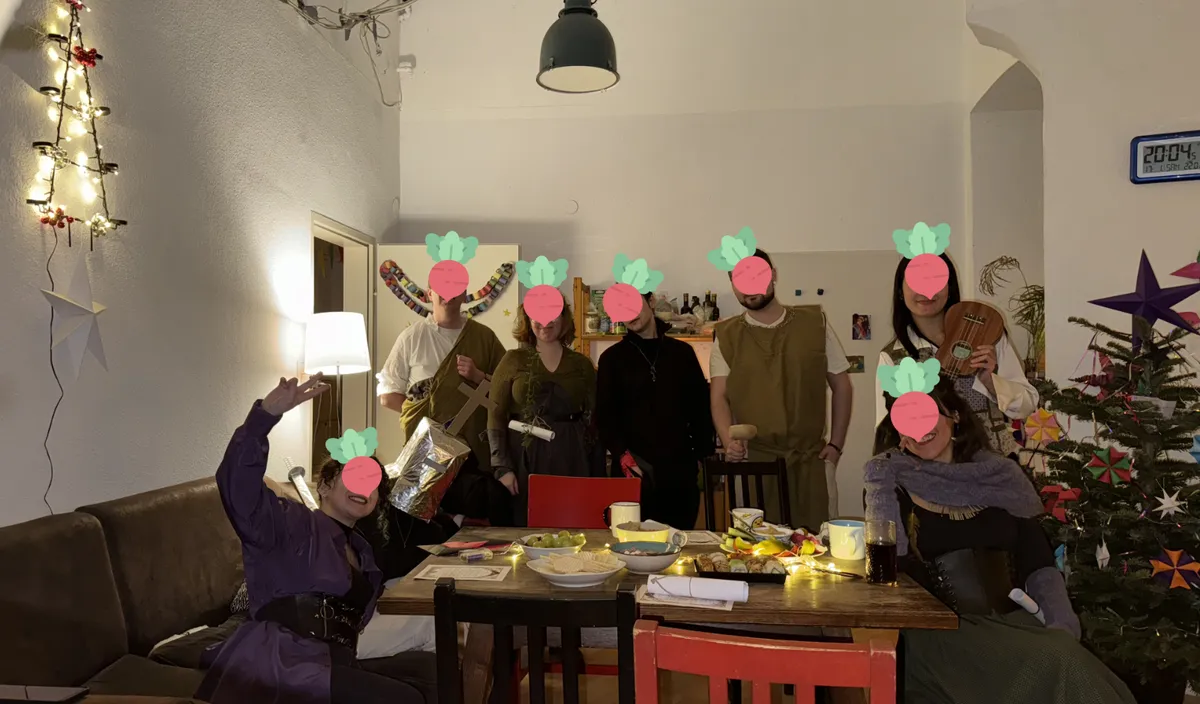
The Concept
The core concept is simple: it is an RPG game hidden inside a social gathering. On the surface, it’s a LARP party filled with dinner, drinks, and casual table games. Beneath it, a shadow game unfolds in real time. Upon arrival, every guest receives a unique profile containing a secret role with mission and victory conditions. As the evening progresses, normal interactions became a battleground for strategic moves and cryptic acts. The event requires no heavy rulebooks and almost no props.
Players will take on one of the following roles:
The Twins of the Silver Waters
Two people bound by fate. They must find each other and remain close while never speaking directly to one another.
The Cursed One
Marked by a swamp witch, they must secretly pass their curse on to three innocent people.
The Retired Guard
A former palace guard who has never quite managed to retire from commanding people. They must casually stop others from completing visible actions.
The Bug Whisperer
A mysterious person with a talent to communicate through the insects. Three tiny messengers must be secretly placed around the castle.
The Shadow Rogue
A member of the Court of the Shadow. They must extinguish the candles while remaining hidden in darkness.
The Oracle
The royal observer. They must watch everyone carefully and identify at least two hidden roles.
The Time Traveller
A visitor from 2026 who somehow ended up in the past. They must smuggle references to three different centuries into a single sentence.
The Cult of the Moon
A secret cult whose members don't know one another. They must recognise their fellow cultists through subtle references to the moon and night and stand together at the final round.
The roles are easy to carry out during dinner and table games, yet subtle enough to keep everyone guessing.
And that is the entire trick: you don't play the game, you live inside it.
Invitation
To begin, you want your guests to feel welcomed, expected and appreciated. Every guest should therefore receive an invitation in advance. It can offer a glimpse into the world you are creating and invite them to prepare a character of their own (with a name, costume and story) while leaving enough space for improvisation once the evening begins. In our case, the invitation looked the following way:
✨ Dear Name, the adventurer! ✨
Allow destiny to summon you on 17 January at 19:00 to Streetname to celebrate the start of the New Year 🏰
There will be games, food, and mischief!
Dress code: Medieval fantasy (crafted only from your wardrobe treasures and garbage-bin magic) 🧙🧙🧙
If you can, please let me know by 14 January whether you'll be joining the quest — it will help me prepare the enchantment spell properly :)
Please feel free to go further. Print it out, write it by hand, send it with the doves.
Let the magic begin before the event starts!
Before the guests arrive
Decorations & Worldbuilding
This is where you let your imagination run wild. Where in the world, universe, or high fantasy is your kingdom set? Who lives there? What nature surrounds them, what gods do they worship, and how is their society structured?
For our event, I drew heavily from the legends of King Arthur, Merlin, Morgana, and early medieval Albion, or at least, the romanticized version assembled in my head from books, paintings, films, and theatre pieces. I am 100% certain this collective fantasy has zero connection to actual history, and that is entirely the point! :D
Instead of stressing over perfection, let your constraints guide you:
- Space: How many rooms do you have access to? Is there an outdoor area?
- Season: What time of year is it, and how can you use it?
- Resourcefulness: What can you move around, borrow, transform, or simply pretend is something entirely different?
You don't need to go into financial debt for a single night. Repeat after me: Garbage and imagination. Let thrift stores, Pinterest, and your own practical intelligence be your best teachers.
A Little Note About Light
There is so much to say about the role of lighting in storytelling that it practically deserves its own post, but for now, ask yourself: what kind of world does your light create? Is it dawn, high noon, or midnight? Is your hall lit by torches, flickering candles, magical crystals, or the glowing souls of elementals?
- Ditch the overheads: Turn off harsh ceiling lights. Opt for warm lamps, candles, and fairy lights.
- Embrace the shadows: Keep a few corners dark. Shadows aren't just atmospheric—they give your guests a sneaky place to complete their secret missions!
- Light the essentials: Keep key spots like the main food station well-lit. (Poisoning your guests at the feast is a bit too medieval.)
- Prioritize safety: Use proper candle holders, keep open flames attended, and make sure loose fabrics stay far away from heat sources.

Music & Soundscapes
Chanting. Ambient tracks. Environmental playlists from Heroes of Might and Magic or Morrowind. Sound is a mighty tool capable of immersing people in your story, so use it wisely.
To build a deeper layer of immersion, ask yourself: What does your castle actually sound like?
- The steady crackle of an open hearth
- Stained-glass windows rattling against a distant storm
- Faint cathedral bells echoing across the courtyard
- Echoing footsteps in a stone corridor
Remember: details create the story. Share these small atmospheric touches with your guests. Tell them about life inside your castle, and let the world come alive around them.
Side Idea: You can turn your sound design into an active mini-game: find bard covers of your friends' guilty-pleasure songs and challenge everyone to guess the original tracks during dinner.
Physical Props
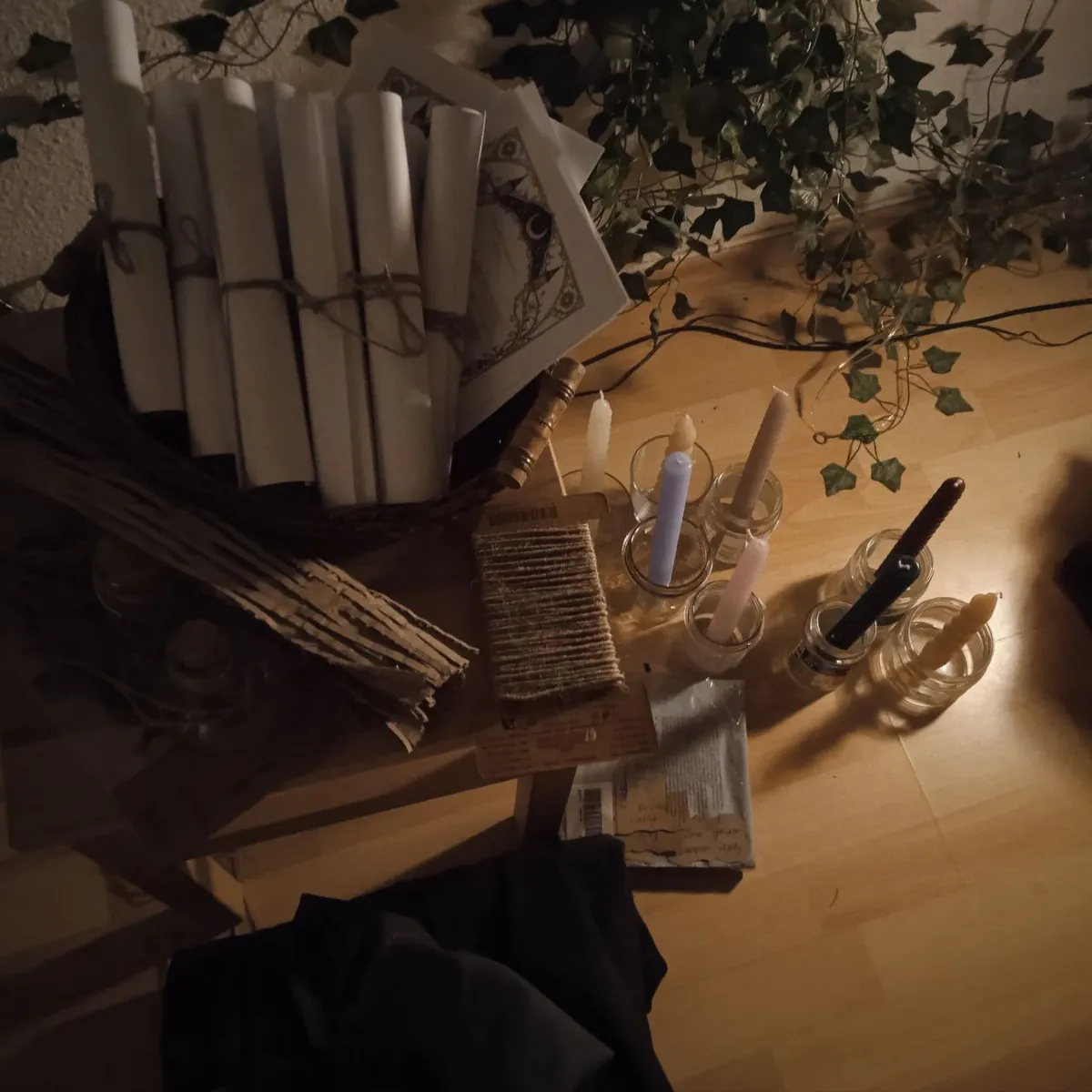
To print:
- Role Descriptions × number of guests (2 copies for the Twins of the Silver Waters and 2–3 copies for the Cult of the Moon)
- General Rules × number of guests
- Oracle Notes × 1
Additional props:
- The Oracle → Oracle Mark (sticker or pin)
- The Cursed One → 3 stickers
- The Bug Whisperer → 3 insect/spider figures
- The Shadow Rogue → 5–8 candles
Host Tip for the Candles: Distribute these throughout the space as standard decorations. Place a few in bright, public areas and put the rest into dim, hidden corners.
Prepping the Player Scrolls
To present each role to your guests, assemble them into secret, sealed scrolls:
- Layer the text: Roll the Role Description together with the General Rules. Face the character details inward and use the General Rules as the outer layer to keep secret identities hidden during handling.
- Attach the props: Secure any required props between the Role Description and General Rules. Stick to flat, lightweight objects that can be easily hidden inside clothing or pockets once unrolled.
- Seal securely: Fasten each scroll thoughtfully so nothing accidentally drops out or reveals a character before the game officially begins.
I. The Arrival
The game begins the moment your guests enter the doorway. For the next few hours, everyone is stepping into character, and total immersion starts with how you greet them. Welcome your guests as they arrive and let them settle into the main lounge area.
Managing Late Arrivals & Final Tweaks
Some guests may—and will—be late! Use this initial window as your final chance to quietly adjust the role distribution based on who is actually in the room:
- Reserve simpler, more flexible roles for anyone arriving late.
- If someone cancels, remove an extra card (like a third Cult of the Moon scroll).
- Always ensure The Oracle, The Twins of the Silver Waters, and at least two members of the Cult of the Moon remain active in the deck.
Once the majority of your guests have settled in, the game officially begins.
II. The Royal Announcement
Once most of your guests have gathered, step forward as the Game Keeper to set the stage with a grand, dramatic opening:
“Dear guests of the Royal Court, I solemnly welcome you this evening! Their Royal Highnesses are delighted to host you at this grand feast, organized in honour of your loyalty and good service to the Throne. Tonight, we shall enjoy endless food, gallons of the finest mead, high elven wine—and, of course, many games!”
You can improvise with the text or use Royal_Announcement.pdf one.
Immediately follow the announcement by introducing the shadow game. Explain that each guest will receive a sealed scroll with a secret identity, a hidden objective, and unique victory conditions that must be fulfilled before the night ends. Emphasize that total secrecy is paramount.
1. Drawing the Roles
Invite guests to draw their scrolls one by one. Once every player holds a scroll, instruct them to scatter around the space to read their cards in total privacy. Give them ample time to digest:
- Who they are
- What they need to do
- How they win
- How they lose
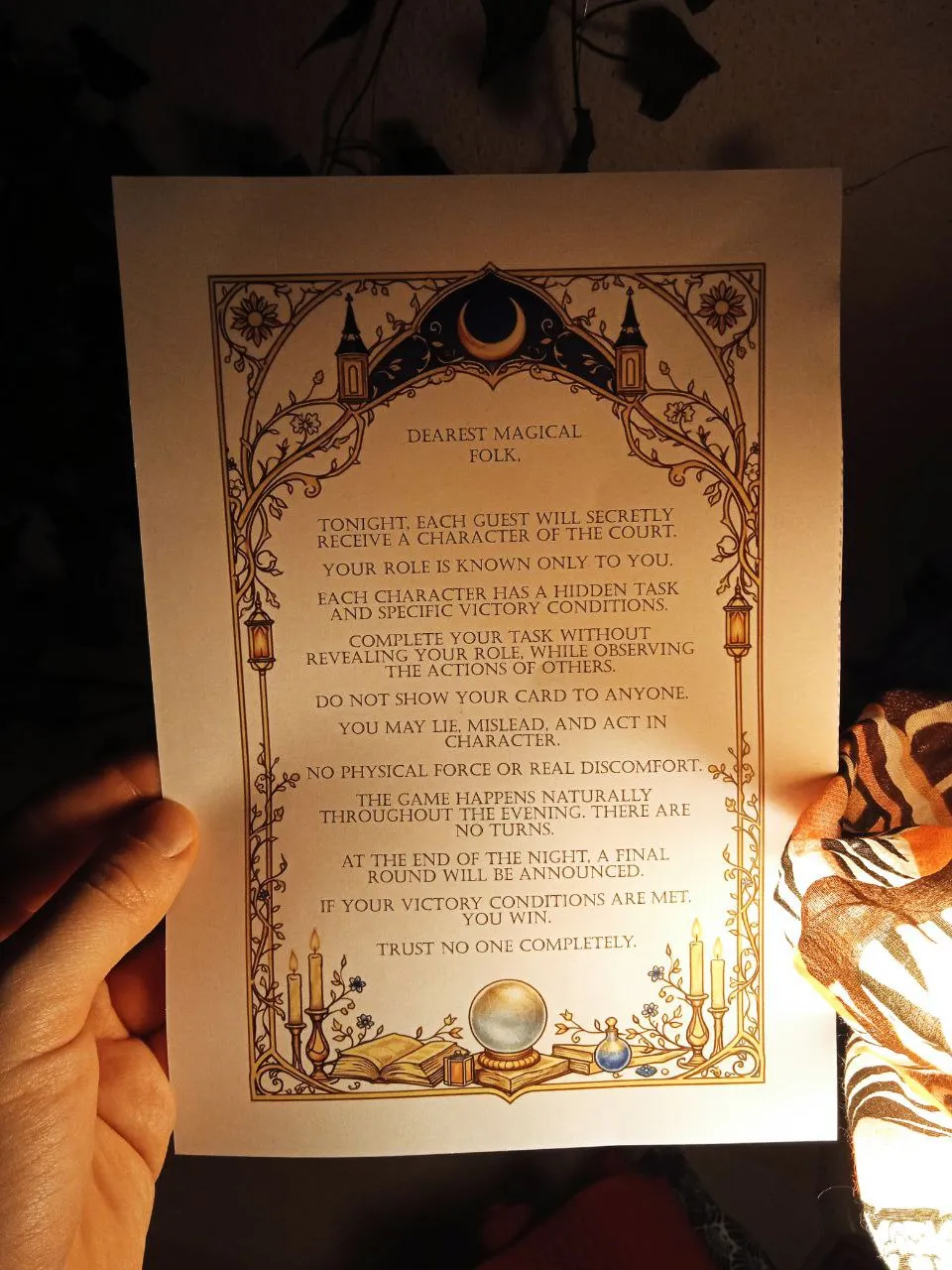
2. Explaining the Core Rules
Gather everyone back together to deliver the fundamental rules:
- Natural Flow: There are no rounds or turns. The game unfolds organically as the party happens.
- Deception Allowed: Players are encouraged to lie, mislead, and stay in character.
- Keep Cards Hidden: No one may show their scroll to another player under any circumstances.
- Standard Loss Conditions: Unless a specific role card states otherwise, a player loses if:
o Someone correctly calls out their secret task aloud before the final round.
o Their role is correctly identified during the final vote.
o They fail to complete their task before the final round begins.
(Note: Role-specific loss conditions always override standard rules.)
Inform the room that the final round will take place later in the evening and that you will give a clear advance warning. With that, set them free: The feast officially begins.
At some point during the feast, The Twins of the Silver Waters will approach you privately to report in. Because they do not know each other's identity at the start, they will almost certainly arrive separately.
1. Track the First Twin: When the first Twin reveals themselves, make a mental note of their identity and keep their secret safe.
2. Wait for the Second: Allow the party to continue normally until the second Twin comes forward.
3. Connect the Bond: Find a discrete moment to pull each Twin aside individually and whisper the name of their missing half. From the exact moment you reveal their identities, their secret bond is forged—and their shared mission begins in earnest.
III. The First Round Table
Once everyone has eaten enough to recover their cognitive skills, gather the room in a circle for official character introductions. This is an ideal moment to deepen the immersion while giving players a natural cover to carry out their secret tasks.
Embrace the Absurdity! Encourage guests to introduce their public characters. Don’t be afraid to let things get delightfully ridiculous. As the Game Keeper, actively throw fuel on their creative fires by adding spontaneous lore into the shared narrative:
“Ah! Surely you all remember when Jackie the werewolf was just a little pup, running through the dark forest on nights of the full moon!”
The more playful details everyone adds, the richer the world becomes.
The Golden Rule of Improvisation: Never shut down a guest's idea. Treat every absurd detail as absolute truth, build on what your players give you, and leave open doors for others to step in.
IV. The Last Call
The game should last around 1.5 to 2 hours (up to 3 hours). About 15 to 20 minutes before time is up, make a subtle, in-character warning to the room:
“The final round approaches...”
This signals the last chance for players to pull off their hidden tasks. When time is officially up, call the room to order:
“The hour of revelation has come. Let the final round begin.”
- Form the Circle
Seat all guests together in a single circle.
- Reveal the Court
Display the official Role Board (a large poster or booklet showing all character names and descriptions). Give everyone a moment to study it.
Remember: Secrets are still active! No one reveals their true identity just yet.
V. The Final Round
The Oracle
The Oracle takes the stage first. As the observant watcher of the Court, they do not vote like the other guests. Instead, they announce their suspicions aloud, naming the players they believe belong to specific roles. Write their predictions down next to the corresponding roles on the board.
Victory Condition: The Oracle wins if they correctly identify at least two player roles.
Loss Condition: If fewer than two predictions are correct, the Oracle loses.
The Investigation
Invite the rest of the Court to approach the board and review the role descriptions.
Once the discussions starts brewing, announce:
“The Court may now name its suspicions.”
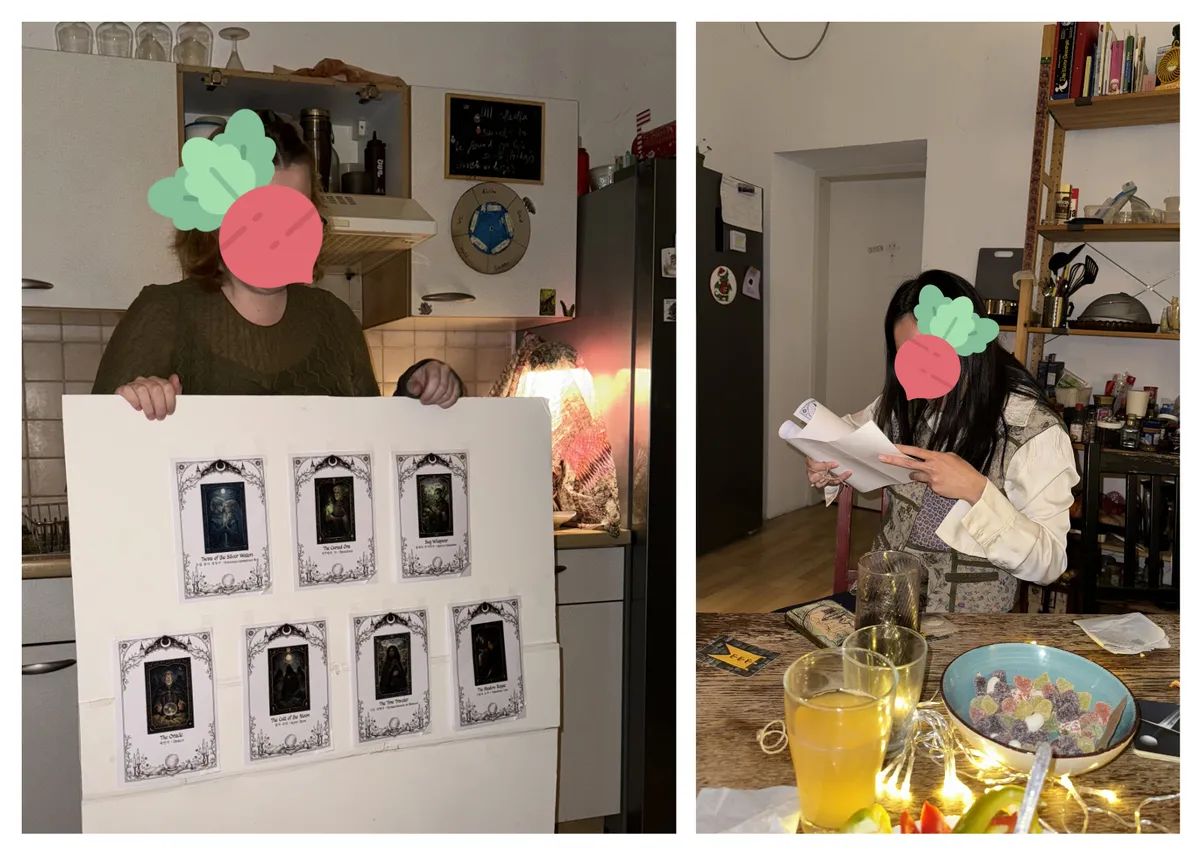
Voting Mechanics
- Each player steps up to the board and writes suspected players' names on stickers, placing them under the corresponding role slots.
- Players may vote on multiple roles if they suspect multiple people.
- Players must continue to conceal their own identity while voting.
Note: As the Game Keeper, you may participate in the voting. However, keep your suspicions to a minimum and try not to call out players whose roles you know by heart.
Counting the votes
Tally the stickers beneath each role on the board to establish the Court's final consensus. Record the totals clearly:
Example: "Anna — 2 votes for The Shadow Rogue"
VI.The Great Revelation
It is the moment of truth!
Starting with the players who received the most votes, invite each guest to step forward, reveal their true identity, and present their physical evidence:
The Cursed One: Shows that all 3 stickers are still successfully attached to other players.
The Bug Whisperer: Reveals where their 3 hidden insect figures were planted.
The Shadow Rogue: Checks whether all assigned candles throughout the room have been extinguished.
The Retired Guard: Recalls the moments they issued commands, which the target players must publicly confirm.
The Time Traveller: Repeats their designated secret sentence and confirms when it was spoken.
The Twins of the Silver Waters: Stand up together to prove they remained side by side during the final round.
The Cult of the Moon: Unveils its secret members and proves their required ritual conditions were met.
The Oracle: Reviews their initial predictions against the real identities.
To win, most roles must satisfy two requirements:
✓ Successfully complete their secret physical task.
✓ Avoid having their role correctly identified by the Court.
The Voting Threshold
For a standard group, set the threshold at 3 correct votes. If a player completed their task but received 3 or more correct votes from the Court, their identity was exposed and they lose.
(Adjust this number up or down depending on your party size, and remember that specific conditions on individual role cards always override standard rules!)
VII.The Grand Finale
Go through every player until the full web of intrigue is untangled. Celebrate your master deceivers, sneaky schemers, sharp investigators, and lucky survivors with applause, sweet treats, ceremonial titles, or a royal hug!
Close the game with a final declaration:
“The secrets of the Court have been revealed. The game is ended... but the Feast continues!”
Turn the ambient music back up, pour more drinks, and let the rest of the night unfold naturally.
The Game Keeper's Golden Rules:
1. Protect the Secret
You know everything. They should know almost nothing.
Never confirm or deny anyone's suspicions. Never accidentally reveal a player's secret role.
2. Protect the Illusion
Let the players discover the world on their own terms. Don't draw attention to suspicious actions—let sneaky players be sneaky. Keep an eye on physical props, candles, and hidden objects without making it obvious why you are watching them.
3. Protect the Party
Most importantly, let the evening feel like an organic gathering, not a rigid, structured tournament.
As the Game Keeper, you are far more than just a rules referee: You are the keeper of the secret. You are the carrier of the magic. And above all, you are the person responsible for ensuring everyone in the room has a ridiculously good time, yourself included!
And that's it!
I hope this article has shown you that you do not need a grandiose venue, a professional team, or years of experience to enter the world of role-playing games. A group of friends, some imagination, a handful of ridiculous props, and a willingness to play along can take you surprisingly far.
So gather your court, light the candles, put on the most suspicious piece of clothing in your wardrobe, and let the story begin!